Author Archives: bp

Poem #20 – Pablo Neruda

from Twenty Love Poems: And a Song of Despair

I can write the saddest poem of all tonight.

Write, for instance: “The night is full of stars,
and the stars, blue, shiver in the distance.”

The night wind whirls in the sky and sings.

I can write the saddest poem of all tonight.
I loved her, and sometimes she loved me too.

On nights like this, I held her in my arms.
I kissed her so many times under the infinite sky.

She loved me, sometimes I loved her.
How could I not have loved her large, still eyes?

I can write the saddest poem of all tonight.
To think I don’t have her. To feel that I’ve lost her.

To hear the immense night, more immense without her.
And the poem falls to the soul as dew to grass.

What does it matter that my love couldn’t keep her.
The night is full of stars and she is not with me.

That’s all. Far away, someone sings. Far away.
My soul is lost without her.

As if to bring her near, my eyes search for her.
My heart searches for her and she is not with me.

The same night that whitens the same trees.
We, we who were, we are the same no longer.

I no longer love her, true, but how much I loved her.
My voice searched the wind to touch her ear.

Someone else’s. She will be someone else’s. As she once
belonged to my kisses.
Her voice, her light body. Her infinite eyes.

I no longer love her, true, but perhaps I love her.
Love is so short and oblivion so long.

Because on nights like this I held her in my arms,
my soul is lost without her.

Although this may be the last pain she causes me,
and this may be the last poem I write for her.

I wake and feel the fell of dark, not day – Gerard Manley Hopkins

[audio:iwakeandfeel.mp3] (1:10)
read by Joan Didion. audio from The Knopf National Poetry Month Collection.

I wake and feel the fell of dark, not day.
What hours, O what black hours we have spent
This night! what sights you, heart, saw; ways you went!
And more must, in yet longer light’s delay.
With witness I speak this. But where I say
Hours I mean years, mean life. And my lament
Is cries countless, cries like dead letters sent
To dearest him that lives alas! away.

I am gall, I am heartburn. God’s most deep decree
Bitter would have me taste: my taste was me;
Bones built in me, flesh filled, blood brimmed the curse.
Selfyeast of spirit a dull dough sours. I see
The lost are like this, and their scourge to be
As I am mine, their sweating selves; but worse.

(1918)

Musée des Beaux Arts – W.H. Auden

About suffering they were never wrong,
The Old Masters; how well, they understood
Its human position; how it takes place
While someone else is eating or opening a window or just walking dully along;
How, when the aged are reverently, passionately waiting
For the miraculous birth, there always must be
Children who did not specially want it to happen, skating
On a pond at the edge of the wood:
They never forgot
That even the dreadful martyrdom must run its course
Anyhow in a corner, some untidy spot
Where the dogs go on with their doggy life and the torturer’s horse
Scratches its innocent behind on a tree.
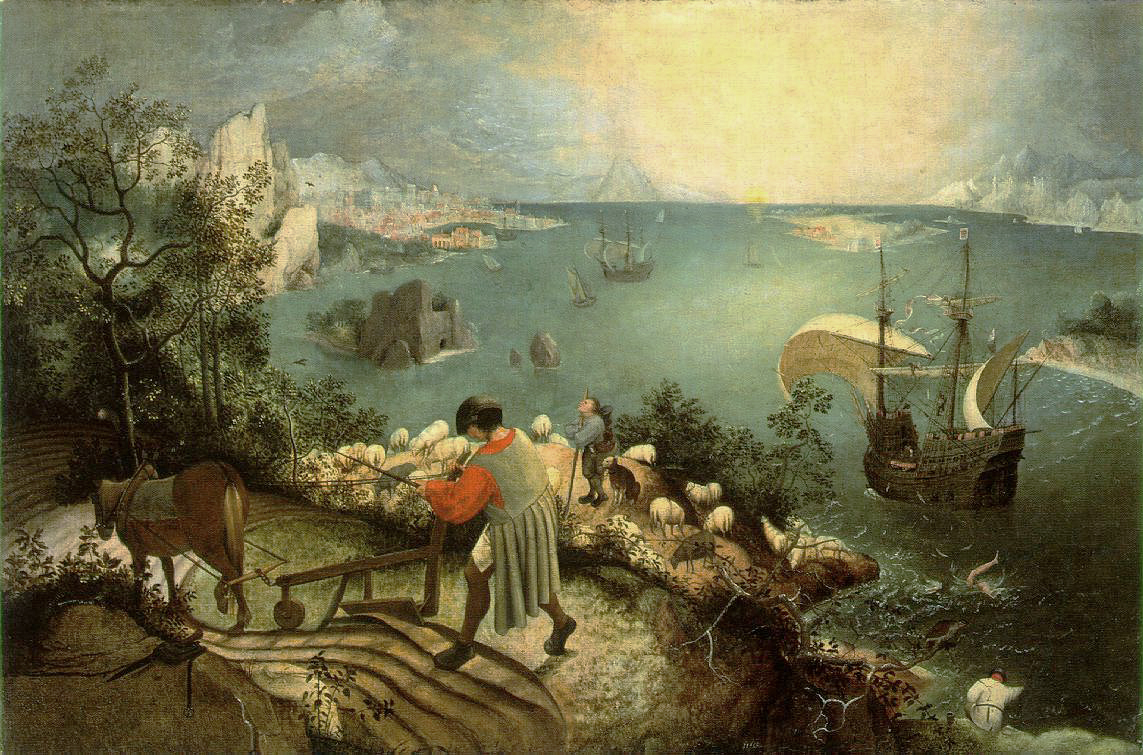
In Breughel’s Icarus, for instance: how everything turns away
Quite leisurely from the disaster; the ploughman may
Have heard the splash, the forsaken cry,
But for him it was not an important failure; the sun shone
As it had to on the white legs disappearing into the green
Water; and the expensive delicate ship that must have seen
Something amazing, a boy falling out of the sky,
had somewhere to get to and sailed calmly on.

—–

Landscape with the Fall of Icarus

Landscape with the Fall of Icarus

One Art – Elizabeth Bishop

The art of losing isn’t hard to master;
so many things seem filled with the intent
to be lost that their loss is no disaster.

Lose something every day. Accept the fluster
of lost door keys, the hour badly spent.
The art of losing isn’t hard to master.

Then practice losing farther, losing faster:
places, and names, and where it was you meant
to travel. None of these will bring disaster.

I lost my mother’s watch. And look! my last, or
next-to-last, of three loved houses went.
The art of losing isn’t hard to master.

I lost two cities, lovely ones. And, vaster,
some realms I owned, two rivers, a continent.
I miss them, but it wasn’t a disaster.

–Even losing you (the joking voice, a gesture
I love) I shan’t have lied. It’s evident
the art of losing’s not too hard to master
though it may look like (Write it!) like disaster.

The Widow’s Lament in Springtime – William Carlos Williams

[audio:widowslament.mp3] (1:01)
read by William Carlos Williams. audio from pennsound. Recorded in Rutherford, NJ. October 7, 1950

Sorrow is my own yard
where the new grass
flames as it has flamed
often before but not
with the cold fire
that closes round me this year.
Thirtyfive years
I lived with my husband.
The plumtree is white today
with masses of flowers.
Masses of flowers
load the cherry branches
and color some bushes
yellow and some red
but the grief in my heart
is stronger than they
for though they were my joy
formerly, today I notice them
and turned away forgetting.
Today my son told me
that in the meadows,
at the edge of the heavy woods
in the distance, he saw
trees of white flowers.
I feel that I would like
to go there
and fall into those flowers
and sink into the marsh near them.