Jimmy Stewart reading a poem on the Johnny Carson show. 7/28/1981
For all dog lovers
1 Reply

Jimmy Stewart reading a poem on the Johnny Carson show. 7/28/1981
[audio:lived_in_a_pretty_how_town.mp3] (2:53)
(audio from: Poetry Out Loud)
(read by David Mason)
anyone lived in a pretty how town
(with up so floating many bells down)
spring summer autumn winter
he sang his didn’t he danced his did
Women and men(both little and small)
cared for anyone not at all
they sowed their isn’t they reaped their same
sun moon stars rain
children guessed(but only a few
and down they forgot as up they grew
autumn winter spring summer)
that noone loved him more by more
when by now and tree by leaf
she laughed his joy she cried his grief
bird by snow and stir by still
anyone’s any was all to her
someones married their everyones
laughed their cryings and did their dance
(sleep wake hope and then)they
said their nevers they slept their dream
stars rain sun moon
(and only the snow can begin to explain
how children are apt to forget to remember
with up so floating many bells down)
one day anyone died i guess
(and noone stooped to kiss his face)
busy folk buried them side by side
little by little and was by was
all by all and deep by deep
and more by more they dream their sleep
noone and anyone earth by april
wish by spirit and if by yes.
Women and men(both dong and ding)
summer autumn winter spring
reaped their sowing and went their came
sun moon stars rain
The New York Times explores the meanings (and poetics?) of the Twitter hashtag. What if Shakespeare had used Twitter? Julia Turner suggests we might have been graced with “Your face. #summerday.” Curiously, he seems to have mostly avoided hashtags altogether.
A new blog captures the accidental poetry of the Google search autofill. Reminiscent of the “Longest Poem in the World” courtesy of Twitter.

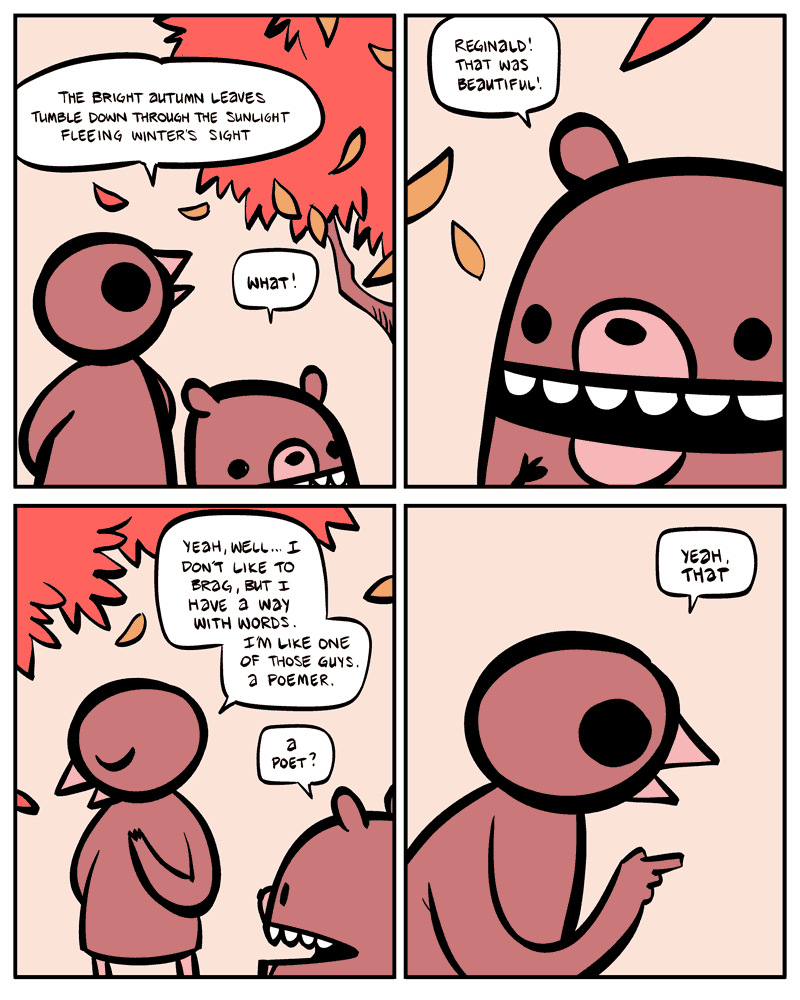
And finally, a little romp from Nedroid Picture Diary.
[audio:Shoveling_Snow_with_the_Buddha.mp3]
(2:22)
(Audio from The Best Cigarette
(Text from Picnic, Lightning)
In the usual iconography of the temple or the local Wok
you would never see him doing such a thing,
tossing the dry snow over a mountain
of his bare, round shoulder,
his hair tied in a knot,
a model of concentration.
Sitting is more his speed, if that is the word
for what he does, or does not do.
Even the season is wrong for him.
In all his manifestations, is it not warm or slightly humid?
Is this not implied by his serene expression,
that smile so wide it wraps itself around the waist of the universe?
But here we are, working our way down the driveway,
one shovelful at a time.
We toss the light powder into the clear air.
We feel the cold mist on our faces.
And with every heave we disappear
and become lost to each other
in these sudden clouds of our own making,
these fountain-bursts of snow.
This is so much better than a sermon in church,
I say out loud, but Buddha keeps on shoveling.
This is the true religion, the religion of snow,
and sunlight and winter geese barking in the sky,
I say, but he is too busy to hear me.
He has thrown himself into shoveling snow
as if it were the purpose of existence,
as if the sign of a perfect life were a clear driveway
you could back the car down easily
and drive off into the vanities of the world
with a broken heater fan and a song on the radio.
All morning long we work side by side,
me with my commentary
and he inside his generous pocket of silence,
until the hour is nearly noon
and the snow is piled high all around us;
then, I hear him speak.
After this, he asks,
can we go inside and play cards?
Certainly, I reply, and I will heat some milk
and bring cups of hot chocolate to the table
while you shuffle the deck.
and our boots stand dripping by the door.
Aaah, says the Buddha, lifting his eyes
and leaning for a moment on his shovel
before he drives the thin blade again
deep into the glittering white snow.
An excerpt from Kurt Vonnegut’s term paper assignment to his students in 1965. Read the full version at Slate:
I invite you to read the fifteen tales in Masters of the Modern Short Story (W. Havighurst, editor, 1955, Harcourt, Brace, $14.95 in paperback). Read them for pleasure and satisfaction, beginning each as though, only seven minutes before, you had swallowed two ounces of very good booze. “Except ye be as little children …”
Then reproduce on a single sheet of clean, white paper the table of contents of the book, omitting the page numbers, and substituting for each number a grade from A to F. The grades should be childishly selfish and impudent measures of your own joy or lack of it. I don’t care what grades you give. I do insist that you like some stories better than others.
…
Do not do so as an academic critic, nor as a person drunk on art, nor as a barbarian in the literary market place. Do so as a sensitive person who has a few practical hunches about how stories can succeed or fail. Praise or damn as you please, but do so rather flatly, pragmatically, with cunning attention to annoying or gratifying details. Be yourself. Be unique. Be a good editor. The Universe needs more good editors, God knows.